
Ennis Previous Residents Source Windows
An address history needs an era map before it needs a conclusion. ECAD gives a current parcel anchor. The county recording index can carry the ownership trail backward until its unverified online cutoff, then the clerk counter and Texas State Library and Archives Commission reels become the documented fallback. Dated directory entries, newspapers, census schedules, permits, and probate records add the household and life-event layer. None is a master list of everyone who lived at an Ennis address.
| Source | Years It Covers | Where Held | What It Shows |
|---|---|---|---|
| ECAD property search | Current-year dynamic result; full history cutoff not located | Ellis Central Appraisal District | Current owner, parcel, tax, mailing and situs clues |
| County online deed index | Online cutoff not located | LGS county record search | Recorded-name index; images have account and payment limits |
| Ellis deed microfilm | 1845 to 1901 | TSLAC reels and county deed books | Grantor and grantee indexes, with direct and reverse paths |
| Ennis city-directory holdings | 1968; 1975 verified | TSLAC; library, UT, and Portal routes for further searching | Dated address, phone, spouse, occupation, or other printed clues |
| Sanborn maps and federal census | Maps irregularly 1884 to 1940; census under the 72-year rule | Library, LOC, UT, and census research routes | Building context, household, ages, relationships, and address context |
| Probate and Ennis Daily News | Probate series vary; newspaper collection represents the 1890s to 1970s and 2010s | County Clerk, TSLAC, and Portal to Texas History | Heirs, estate clues, notices, obituaries, and address leads |
Use the source that matches the time period. An address in a current appraisal record calls for ECAD and the deed index first. A nineteenth-century question starts with the legal description, historic indexes, maps, and county books. A mid-century household question may require a directory and the Ennis Daily News as well as the owner chain.
Anchor Ennis Previous Residents in ECAD
Begin at the Ellis Central Appraisal District property search with the current situs address. Save the owner name, property ID, geographic ID, legal description, subdivision, lot and block, tax mailing address, and any deed or reference field that appears. A situs address identifies where the parcel is. A tax mailing address is where notices go. They can be different, including when a local parcel's mail goes outside Ennis.
The legal description is the steadier bridge when a street number changed, a parcel split, or an older deed lacks a modern-style address. ECAD's dynamic search supports owner name, property ID, owner ID, geographic ID, reference ID, tax office ID, property address, compound text, and advanced search. It is useful for a present anchor, but the exact online historical cutoff was not located and the tax roll is not an occupant roster.
The Ennis Public Library genealogy and regional-history resources place an ECAD search within a broader local address-history workflow.
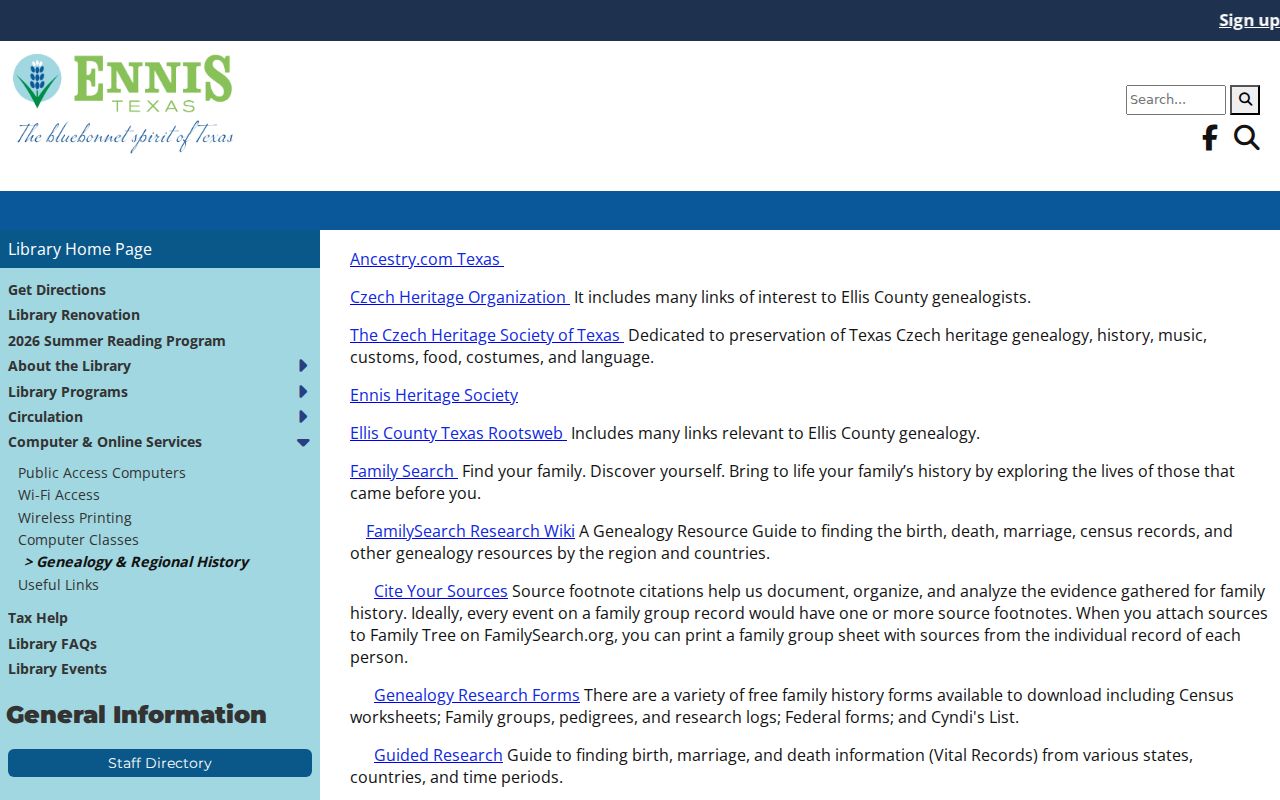
The library genealogy links place an ECAD search within a broader Ennis address-history workflow of maps, directories, newspapers, and archives.
Tracing Ennis Previous Residents by Deed
The deed chain identifies legal owners, not all past residents. Use the LGS county record search to locate the current owner as a grantee, using the legal description and party-name variants where needed. The acquisition deed supplies a prior grantor or seller, recording date, and document placement. Then search that seller as a grantee for the earlier acquisition. Repeating that handoff moves the title trail backward one recorded transaction at a time.
- Save the current ECAD owner, parcel identifiers, situs address, tax mailing address, and legal description.
- Search the owner as grantee in the county recording index and capture the acquisition document details.
- Record the seller or prior grantor, then search that person as a grantee in an earlier period.
- Repeat the sequence, comparing lot, block, plat, and legal description at every handoff.
- Move to the clerk counter, original books, and TSLAC reels when the online result ends or a same-name conflict remains.
- Grantor
- The person or entity transferring an interest in a recorded instrument.
- Grantee
- The person or entity receiving that interest. Searching a former seller as grantee can locate an earlier purchase.
- Chain of title
- The sequence of recorded ownership transfers for the same legally described property.
- Legal description
- The lot, block, subdivision, abstract, or metes-and-bounds description that distinguishes one parcel from a nearby address.
Use deed title evidence and household evidence together, but do not merge them. A sale date does not prove that a buyer moved in that day. A directory may name a spouse or boarder while the tax roll names only an owner and mailing destination.
Ennis Historic Deed Index Fallback
When LGS reaches an unknown cutoff, do not fill the gap by guesswork. The Ellis County Clerk counter and public terminals are documented alternatives, with property and vital-record service at 972-825-5070 during the clerk's Monday through Friday, 8:00 a.m. to 4:30 p.m. hours. The clerk is in Waxahachie, which is the county seat even though the property is in Ennis. County original books are part of the fallback chain for older material.
The TSLAC Ellis County microfilm listing confirms deed records from 1845 through 1901, with direct and reverse indexes. It also identifies marriage records from 1850 through 1934, probate administration bonds from 1852 through 1936, probate dockets from 1880 through 1935, and probate minutes from 1850 through 1946. Some original-series transcriptions are not always accurate, so compare the index with the underlying instrument where it is available.
Insider tip. LGS guest login provides index information. Image access requires registration or purchase, and the documented transaction fee is $0.30. Record the index details before deciding whether an image is needed.
Review the TSLAC Ellis County reel coverage before shifting a deed-chain search to historic records.
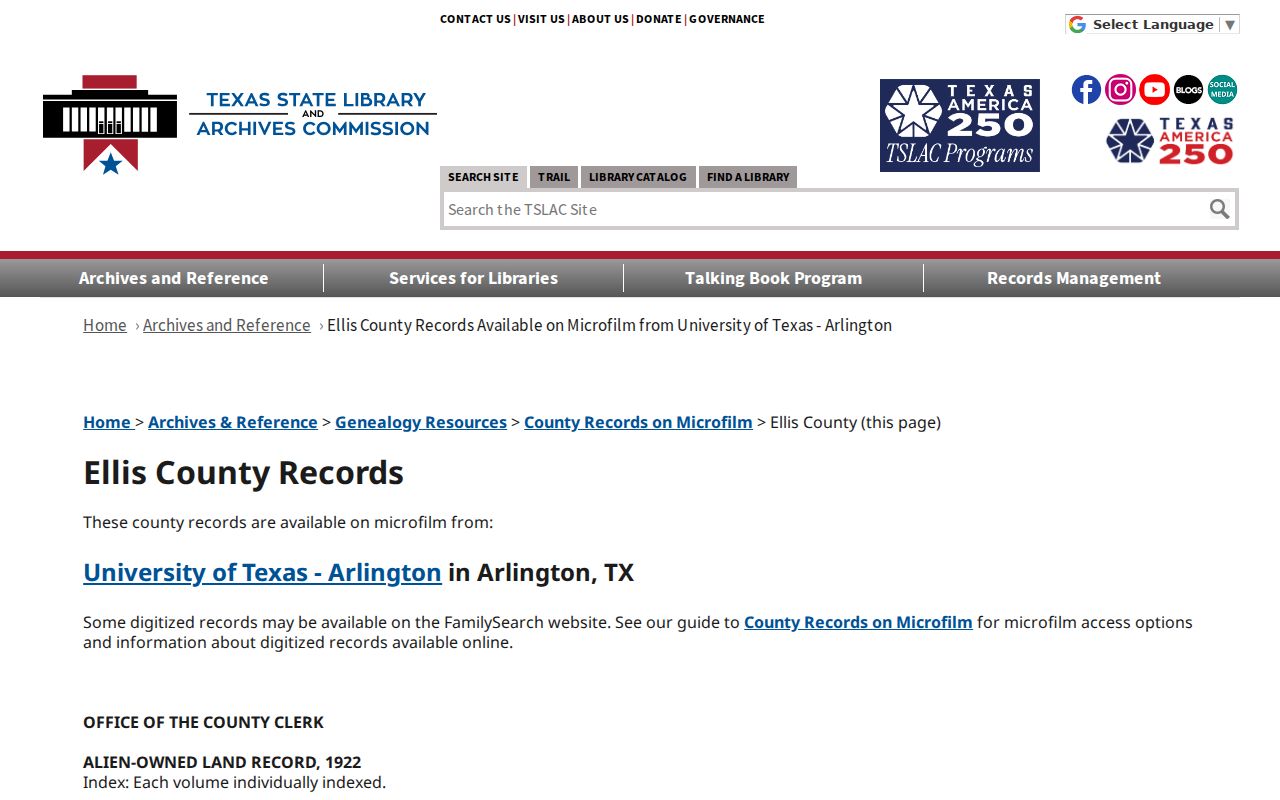
The microfilm listing provides a verified historic path when a modern index has an undisclosed online coverage boundary.
Ennis Previous Residents Between Deeds
A deed gap is where household sources do their best work. TSLAC verifies Ennis city-directory holdings for 1968 and 1975, while the complete Ennis publisher and year run remains unverified. A directory may provide a dated address, telephone, spouse, occupation, or other printed clue. In a criss-cross section, the street-and-number order can lead from an address to the occupant listed for that edition. The historical collections themselves are described in the Ennis city directory collections.
The Ennis Daily News collection adds notices, obituaries, organizations, advertisements, and address variants. It has 10,345 digitized items across five titles and ten decades. Use a surname, an old street form, a cross street, and an organization or railroad or cotton term in separate searches. A newspaper notice can explain a gap, but it is not a deed, certificate, or proof of a person's current location.
Myth. A complete deed chain does not name every person who lived at an Ennis address. It records title transfers. Directories, census schedules, and newspapers are separate, dated household clues.
Note: Keep the address spelling from each source, even when a later parcel card uses a different number or street form.
Ennis Sanborn and House History
The Ennis Heritage Society research guidance gives a direct local route: ask the library for the Archives Collection and address-indexed house files, then check the 1986 Historic Resources of Ennis, Texas survey and its 1997 update. Those resources can identify survey notes or historic-property context. They are especially valuable when a directory entry or deed uses a street label that does not line up cleanly with a current parcel display.
Sanborn maps place the building in time without identifying its occupants. Ennis sheets appear irregularly from 1884 through 1940. Start with the latest available sheet, usually 1925 in the Heritage Society's method, and work backward through street labels, building outlines, stories, materials, and outbuildings. One linked route says 1920 is the latest online sheet, so verify the sheet date rather than assuming every later map is digitized.
ECAD's Year Built field is a lead, not a construction verdict. The Society warns that it may reflect a substantial remodel or revaluation. Corroborate it with the Sanborn footprint, permit dates, newspaper construction notices, deed descriptions, and survey inventory. No official Ennis street-renumbering year was verified. Search old and current street names, nearby cross streets, lot and block, and legal descriptions instead of trusting a single modern address string.
Ennis Previous Residents Census Pairing
Pair a directory or address clue with the nearest public federal census schedule. Census access follows the 72-year rule, and the Ennis library genealogy resources point toward TSLAC, UT, UNT, Portal to Texas History, library-licensed Ancestry and HeritageQuest, Sanborn links, and the Library of Congress. A census can add household members, ages, relationships, and occupations. Its enumeration address may differ from the directory or current street form, so do not erase either version.
- Write down the dated directory or newspaper address exactly as printed.
- Check a Sanborn sheet and legal description for the physical parcel or nearby cross streets.
- Locate the nearest available census household and compare names, ages, relationships, and address context.
- Search the next directory year and Ennis Daily News notices for moves, deaths, or spelling changes.
- Return to deeds or probate if a title change, heir, or estate detail needs confirmation.
County and city limits, postal labels, census enumeration practices, and street numbers can change independently. Treat disagreement as a research problem to reconcile, not a reason to discard a dated record.
Ennis Probate Trail Endpoints
For a deceased owner, probate can connect an estate with an executor, administrator, heirs, addresses, wills, and later conveyances. The County Clerk holds probate and guardianship material, and the historic TSLAC series provides bonds, dockets, and minutes for the stated periods. Search an obituary or Ennis Daily News death notice as a clue, then test the date and names against a probate docket, will, heirship filing, or later deed of distribution. A newspaper alone is not the authoritative estate instrument.
Protected or sealed filings are not ordinary public search material. If a portal lacks the record, use the clerk counter or ask for a specific existing record through the Texas Public Information Act process where appropriate. A focused request should identify the estate, address, date range, or document number. It should not ask staff to create a new list of former Ennis residents.
Ennis Previous Residents Address Limits
Keep the conclusion as narrow as the source. ECAD may show an owner and tax-mailing destination. A recorded deed can show a transfer. A city directory may show a dated listing. A census can show a household at its enumeration date. Each can support a piece of an Ennis address history, but none turns a public record trail into a complete current roster.
Lawful personal research. Use past-residents information for family history, estate work, property history, or personal curiosity. Do not use an address trail to track, threaten, stalk, or harass a living person.
Historic designation can create another record path. The Ennis historic-district requirements state that exterior work visible from public rights of way may require a Certificate of Appropriateness, and demolition or relocation has a certificate path. Designated-property records can add survey or alteration context, not proof that any particular person lived there.
Note: Preserve the record source, date, and legal description with every past-residents conclusion so another researcher can test it.